Artificial Intelligence Courses
Artificial intelligence courses can help you learn machine learning algorithms, natural language processing, computer vision, and neural networks. You can build skills in data analysis, predictive modeling, and automating tasks using AI techniques. Many courses introduce tools like TensorFlow, PyTorch, and Scikit-learn, that support implementing AI solutions and developing applications that leverage these advanced technologies.
Popular Artificial Intelligence Courses and Certifications
 Status: Top AI Program
Skills you'll gain: Prompt Engineering, Prompt Patterns, Unit Testing, Large Language Modeling, LangChain, Retrieval-Augmented Generation, Data Wrangling, Responsible AI, Exploratory Data Analysis, Unsupervised Learning, Model Evaluation, Generative Model Architectures, PyTorch (Machine Learning Library), ChatGPT, Generative AI, LLM Application, Keras (Neural Network Library), Vector Databases, Fine-tuning, Data Import/Export
 Status: Free Trial
Skills you'll gain: Responsible AI, Machine Learning Methods, Generative AI Agents, Generative AI, Prompt Patterns, Generative Model Architectures, Prompt Engineering Tools, AI literacy, Risking, Retrieval-Augmented Generation, LLM Application, Agentic systems, Machine Learning Algorithms, Natural Language Processing
 Status: Free Trial
Google
Skills you'll gain: Generative AI, Artificial Intelligence and Machine Learning (AI/ML), AI Enablement, AI literacy, Model Training, Machine Learning, Innovation, Critical Thinking
 Status: Preview
DeepLearning.AI
Skills you'll gain: AI Product Strategy, Responsible AI, Data Ethics, AI Enablement, Applied Machine Learning, Artificial Intelligence, AI literacy, Machine Learning, Data Science, AI Integrations, Deep Learning, Artificial Neural Networks
 Status: NewStatus: Preview
Birla Institute of Technology & Science, Pilani
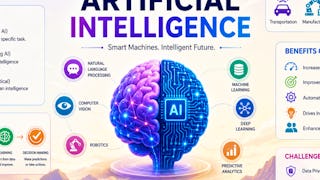
Skills you'll gain: Artificial Intelligence, Artificial Intelligence and Machine Learning (AI/ML), Reinforcement Learning, Computational Logic, Agentic systems, Bayesian Network, Decision Intelligence, Machine Learning, Bayesian Statistics, AI literacy, Markov Model, Algorithms, Computational Thinking, Probability, Model Optimization, Probability & Statistics, Probability Distribution
 Status: Top AI Program
University of Pennsylvania
Skills you'll gain: AI Personalization, Machine Learning Methods, Fraud detection, Generative AI, Responsible AI, Data Ethics, Data Management, Data Strategy, People Analytics, HR Tech, Generative Model Architectures, AI Enablement, Human Resource Management, AI Product Strategy, Data Governance, Human Resources Management and Planning, Big Data, Credit Risk, Machine Learning, Analytics
What brings you to Coursera today?
 Status: Top AI Program
Skills you'll gain: Prompt Engineering, Prompt Patterns, Responsible AI, ChatGPT, Generative AI, Machine Learning Methods, Generative AI Agents, IBM Cloud, Generative Model Architectures, Prompt Engineering Tools, Risking, AI Workflows, Application Deployment, AI literacy, Machine Learning Software, Business Workflow Analysis, Workflow Management, Machine Learning, Deep Learning, Data Science
 Status: Top AI Program
Amazon Web Services
Skills you'll gain: Artificial Intelligence and Machine Learning (AI/ML), Generative AI, Deep Learning, Artificial Intelligence, Amazon Web Services, Applied Machine Learning, AI literacy, Machine Learning, Digital Transformation
 Status: Top AI Program
Vanderbilt University
Skills you'll gain: Prompt Engineering, Retrieval-Augmented Generation, ChatGPT, Agentic Workflows, Prompt Patterns, Generative AI Agents, Generative AI, AI Workflows, AI Enablement, Agentic systems, Strategic Decision-Making, Business Intelligence, Business Leadership, Data-Driven Decision-Making, Automation, Organizational Leadership, Strategic Planning, Planning, Talent Acquisition, Procurement
 Status: Free Trial
University of Pennsylvania
Skills you'll gain: Agentic systems, Artificial Intelligence, Algorithms, AI literacy, Python Programming, Responsible AI
 Status: Job Ready
University of Colorado Boulder
Skills you'll gain: Prompt Engineering, New Product Development, Model Based Systems Engineering, Model Evaluation, Generative AI, Financial Statement Analysis, Sustainable Business, Data Mining, Field-Programmable Gate Array (FPGA), Delegation Skills, Strategic Decision-Making, Real-Time Operating Systems, Object Oriented Design, Project Schedules, Sampling (Statistics), Failure Analysis, Data Ethics, Goal Setting, Database Design, Data Visualization


Skills you'll gain: Large Language Modeling, Artificial Intelligence and Machine Learning (AI/ML), MLOps (Machine Learning Operations), Artificial Intelligence, Cloud Management, Generative AI, AI Orchestration, Cloud Deployment, Infrastructure Architecture, Cloud Infrastructure, Cloud Computing, AI Workflows, Devops Tools, Data Infrastructure, AI literacy, Deep Learning, Information Technology Operations, Machine Learning, Network Infrastructure, Data Centers
What brings you to Coursera today?
In summary, here are 10 of our most popular artificial intelligence courses
- IBM Generative AI Engineering: IBM
- Introduction to Artificial Intelligence (AI): IBM
- Introduction to AI: Google
- AI For Everyone: DeepLearning.AI
- Artificial Intelligence: Birla Institute of Technology & Science, Pilani
- AI For Business: University of Pennsylvania
- AI Foundations for Everyone: IBM
- Fundamentals of Machine Learning and Artificial Intelligence: Amazon Web Services
- Generative AI Strategic Leader: Vanderbilt University
- Artificial Intelligence Essentials: University of Pennsylvania










