Politics Courses
Politics courses can help you learn about political theory, governance structures, electoral systems, and public policy analysis. You can build skills in critical thinking, debate techniques, and effective communication strategies. Many courses introduce tools like data analysis software for interpreting political trends and survey tools for gauging public opinion, that support understanding voter behavior and shaping campaign strategies.
Popular Politics Courses and Certifications
 Status: Preview
Yale University
Skills you'll gain: Political Sciences, Policy Analysis, Social Justice, Social Studies, Public Policies, Economics, Policy, and Social Studies, Social Sciences, Law, Regulation, and Compliance, Governance, Sociology, Ethical Standards And Conduct, Liberal Arts, Socioeconomics, Economics
 Status: Preview
University of London
Skills you'll gain: Diplomacy, International Relations, Political Sciences, Cultural Diversity, Intercultural Competence, Cultural Sensitivity, World History, Conflict Management, Policy Analysis
 Status: Preview
Università di Napoli Federico II
Skills you'll gain: International Relations, Political Sciences, Social Studies, Social Sciences, World History, Governance, Environmental Issue, Cultural Diversity, Research Methodologies, Public Safety and National Security, Economics, Security Strategy, Conflict Management, Climate Change Adaptation
Johns Hopkins University
Skills you'll gain: Political Sciences, Policy Analysis, Social Studies, Social Justice, Public Affairs, Mathematics and Mathematical Modeling, Social Sciences, Public Policies, Game Theory, Demography, Mathematical Modeling, Governance, Decision Intelligence, Combinatorics, General Mathematics, Diversity Awareness, Applied Mathematics
 Status: Free
Utrecht University
Skills you'll gain: Lobbying, Social Justice, Political Sciences, Economics, Policy, and Social Studies, Socioeconomics, Tax Laws, Civil Law, Social Sciences, Economics, Policy Analysis, Public Affairs, Liberal Arts, Public Policies, Governance, International Finance
 Status: Free Trial
University of Illinois Urbana-Champaign
Skills you'll gain: Supply And Demand, Economics, Market Dynamics, Business Economics, Behavioral Economics, Policy Analysis, Business, Economics, Policy, and Social Studies, Business Operations, Revenue Management, Consumer Behaviour, Social Studies, Operations, Political Sciences, Social Sciences, Business Strategy, Public Policies, Competitive Analysis, Market Analysis, Socioeconomics
What brings you to Coursera today?
 Status: NewStatus: Free Trial
University of Michigan
Skills you'll gain: Policy Analysis, Research, and Development, Community Organizing, Policy Development, Social Justice, Social Work, Public Policies, Sustainable Development, Sustainable Systems, Community Development, Community and Social Work, Political Sciences, Health Policy, Advocacy, Social Impact, Economics, Policy, and Social Studies, Policy Analysis, Sustainable Business, Strategic Leadership, Systems Thinking, Cultural Diversity
 Status: Free Trial
IIMA - IIM Ahmedabad
Skills you'll gain: Leadership Studies, Leadership, Leadership Development, Team Leadership, Leadership and Management, Organizational Leadership, Business Leadership, Emotional Intelligence, Business Ethics, Culture Transformation, Personal Development, Empathy & Emotional Intelligence, Personal Attributes, Influencing, Organizational Change, Self-Awareness, Ethical Standards And Conduct, Industrial and Organizational Psychology, Relationship Building, Mindfulness
 Status: Preview
Università di Napoli Federico II
Skills you'll gain: Political Sciences, Critical Thinking, Case Studies, Research, Social Sciences, Governance, Sociology, Interactive Learning, Public Administration, Research Methodologies
 Status: Preview
Yale University
Skills you'll gain: Behavioral Economics, Storytelling, Economics, Economics, Policy, and Social Studies, Financial Forecasting, Forecasting, Socioeconomics, Social Studies, Market Dynamics, Consumer Behaviour, Automation
 Status: Preview
Skills you'll gain: Oil and Gas, Petroleum Industry, Energy and Utilities, Climate Change Mitigation, International Relations, Environmental Issue, Electric Power Systems, Environment and Resource Management, Economic Development, Natural Resource Management, Environmental Policy, Economics, Political Sciences, Economics, Policy, and Social Studies, Social Studies, Sustainable Technologies, Market Dynamics, Sustainable Development

 Status: Preview
The Hong Kong University of Science and Technology
Skills you'll gain: Political Sciences, Policy Development, Public Policies, Policy Analysis, Economics, Policy, and Social Studies, Social Sciences, International Relations, Socioeconomics, Economics, Economic Development, Governance, Culture
What brings you to Coursera today?
In summary, here are 10 of our most popular politics courses
- Moral Foundations of Politics: Yale University
- Global Diplomacy – Diplomacy in the Modern World: University of London
- Global Politics: Università di Napoli Federico II
- The Mathematics of Democracy, Politics and Manipulation: Johns Hopkins University
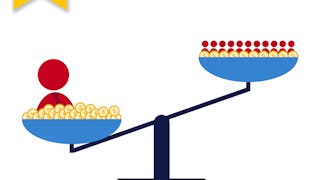
- Inequality and Democracy: Utrecht University
- Microeconomics Principles: University of Illinois Urbana-Champaign
- Social Impact & Public Policy: University of Michigan
- Leadership Skills: IIMA - IIM Ahmedabad
- Understanding Political Concepts: Università di Napoli Federico II
- Narrative Economics: Yale University










